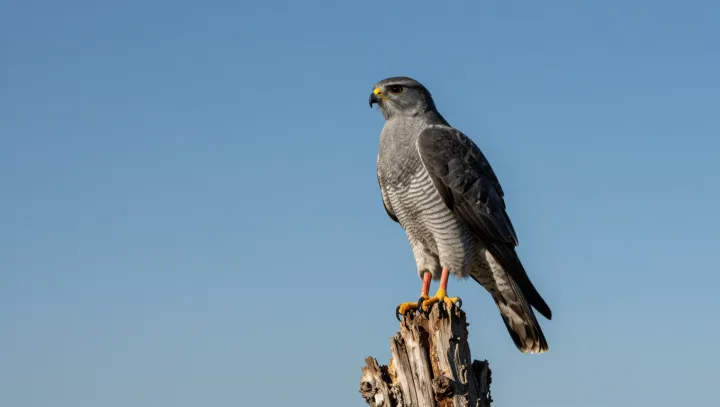
For the eastern chanting goshawk, the best attack often begins with stillness, not pursuit. From an exposed branch or other raised perch, the gray raptor surveys the ground before dropping toward prey. Its long orange-red legs are conspicuous against the bird's plumage. The perch does much of the work.
Height offers an advantage. Above grass and scrub, a goshawk can scan a wider area and detect movement that might be hidden from ground level. This is a form of ambush predation: the bird waits for an opportunity rather than continuously searching on the wing. Insects, lizards and small mammals can all be targets, and a descent brings the hunter quickly into reach of animals that may have little reason to look upward. Not every strike succeeds, of course; cover, distance and the prey's own escape response can frustrate an attack.
The accounting also favors patience. A perch supplies gravitational potential energy, some of which becomes kinetic energy during a descent, reducing the need for flapping on that part of the approach. Waiting is not free: the bird must reach a perch, remain alert and sometimes move when the view yields nothing. Nor does this explain every hunting choice. The balance between watching and flying changes with prey, vegetation and available perches, and the precise energy savings are not established here. Still, the contrast is telling: while its quarry moves through the grass, the goshawk can let height and gravity bring the chase to it. For a moment, the hunter is simply a gray shape against the sky.