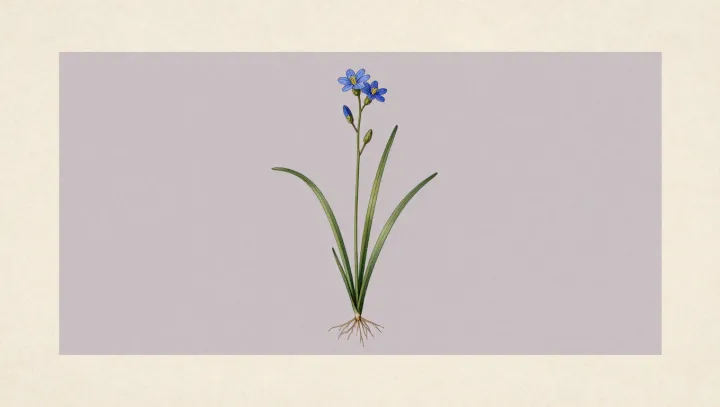
The leaves tell a misleading story. Narrowleaf blue-eyed grass wears the slender blades of a grass, but its small blue flowers, each lit by a yellow center, point toward a different family. The resemblance above ground is real; the family connection lies deeper.
The flower makes the stronger case. Its six petal-like parts, called tepals, and three stamens fit the floral pattern associated with the iris family, Iridaceae. Its inferior ovary sits below the other flower parts, another feature shared with irises. True grasses belong to a separate family, Poaceae, and generally bear much less conspicuous flowers enclosed by bracts. Neither a blue star nor a single anatomical feature is proof by itself; the combination carries the argument.
The narrow blade is less dependable as a family marker. Similar leaf shapes can arise independently in plants facing similar conditions, a process known as convergent evolution. Leaves also vary considerably within plant families, while reproductive structures supply a suite of traits that botanists can compare across related groups. Molecular evidence adds another line of inquiry when appearances disagree. The plant's common name preserves the first impression; its flower quietly offers a different account.