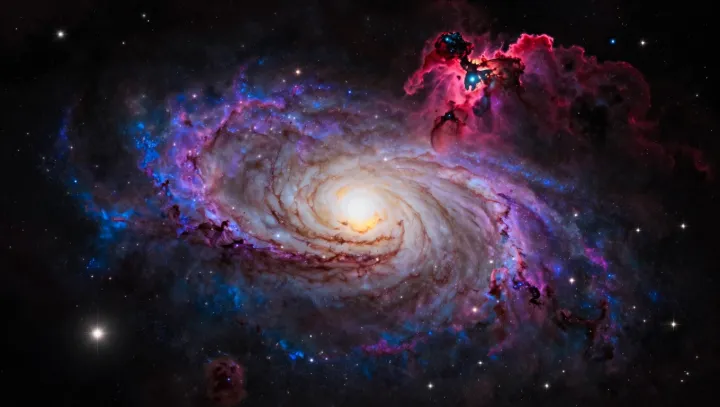
Spiral arms are not ropes of stars, and that distinction saves them from a seemingly inevitable fate. In a rotating galaxy, inner regions generally complete an orbit faster than outer ones; if the same stars remained tied together in each arm, the pattern would wind itself into a tight coil.
The more persuasive picture separates the pattern from its ingredients. Density wave theory treats some arms as regions of enhanced density moving through the galactic disk, with stars and gas passing in and out rather than traveling permanently alongside them. The effect resembles a traffic jam, though gravity, not braking drivers, helps organize the crowd. Gas compressed within an arm can form new stars; massive young stars shine brightly and make the structure easier to see. A density wave need not be permanent to resist the simple winding problem.
No single explanation fits every galaxy. Computer simulations and observations also support transient spiral arms that form, change shape and fade, sometimes with help from gravitational interactions with neighboring galaxies. Such arms can rotate at speeds that vary with their surroundings, rather than behaving as one rigid pattern. Even the colorful clouds in an illustration should be read with care: they suggest gas and dust, not proof that every bright streak marks the same physical process. The image holds still. The galaxy does not.