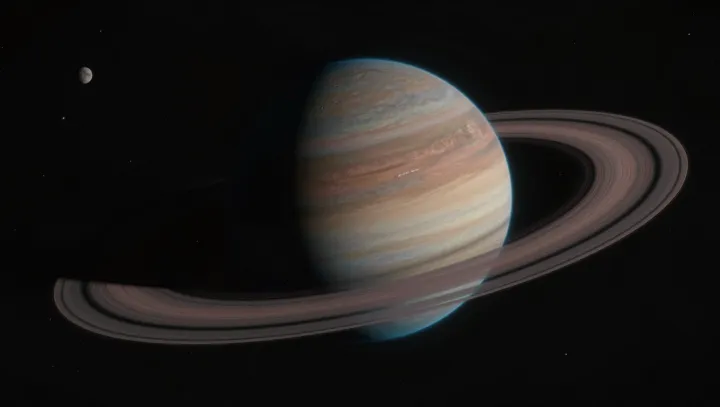
A moon can be both the architect of a ring and its future wreckage. Gravity decides much, but not everything. In an imagined system of a ringed exoplanet and several moons, the balance between orbital motion, material strength and destructive collisions would determine whether a moon remains intact or joins the debris it once helped shape.
The moon's first role is often constructive. A moon orbiting near a ring can exchange angular momentum with ring particles, pushing some into gaps or confining them near an edge. Orbital resonance, in which repeated gravitational encounters accumulate at particular distances, can sharpen those effects. Saturn offers examples close to home: its moons influence ring structure, although not every sharp edge needs a shepherd moon. The pattern matters. A ring is not a rigid disc but a multitude of particles moving on separate orbits, each responding to the planet, nearby moons and its neighbors.
Survival, however, depends on where a moon travels and what holds it together. Inside the Roche limit, tidal forces can overwhelm the self-gravity of a loosely bound body; a compact object with enough material strength may resist disruption closer in. Collisions can also strip or shatter a moon, while tidal interactions with the planet may move its orbit inward or outward. The debris must then remain in orbit rather than fall onto the planet or escape. None of this is a prediction for the illustrated world, which is imagined rather than measured. There, suspended in the drawing, the same moon may seem both keeper and captive of the ring.