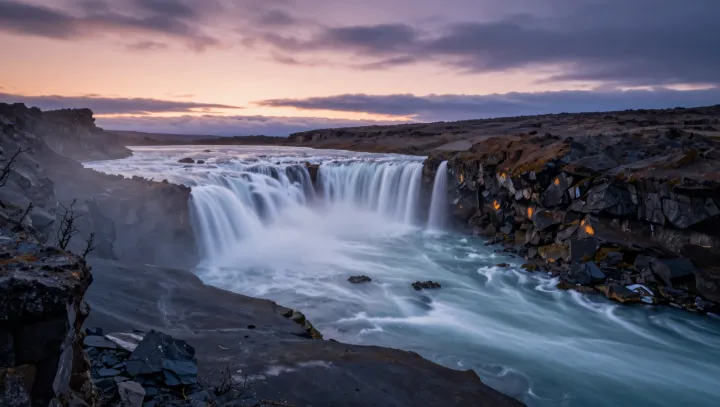
The cliffs beneath some Icelandic waterfalls are records of cooling, not elaborate masonry. Their columns began as molten basalt, which contracted as it solidified and cracked into a pattern that often favors six sides. Water arrived later. At Svartifoss, the dark pillars frame the falling stream like pipes in a stone organ.
The geometry is less precise than it first appears. As a lava flow loses heat, thermal contraction creates stress; when the rock can no longer withstand it, fractures spread through the cooling mass. These cracks tend to intersect at angles that can produce hexagonal columns, although five or seven sides are common, and real columns are rarely perfect. The fractures advance roughly perpendicular to the cooling surface, so their orientation can reveal the direction in which solidification progressed. Column width can also offer clues to cooling conditions, though it is not a simple thermometer: composition, thickness and water exposure can all matter.
The waterfall is an editor, not the architect of the columns. Erosion removes rock and can expose the fractured interior of an old flow, while the stream follows a drop in the underlying bedrock. At Svartifoss, the exposed columns offer a view into a process that unfolded out of sight, long before the present cascade took shape. The water keeps moving; the stone holds the memory of heat.