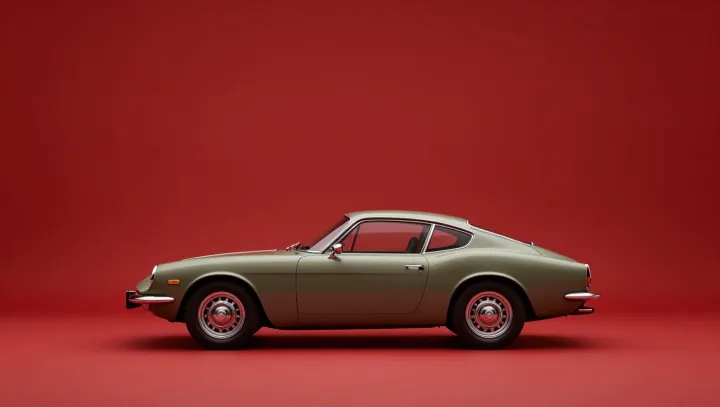
A sweeping roofline on a bold red backdrop now reads less like crash physics and more like couture. The same silhouettes that once chased lower drag coefficients and stronger crumple zones have become aesthetic shorthand for status, precision and desire in high-fashion imagery.
Early luxury car forms were dictated by wind tunnel data, impact dynamics and the geometry of the safety cage. Curved hoods, narrowed glass areas and tapering tails were ways to manage laminar flow and energy absorption, not to manufacture glamour. Yet the brain’s visual cortex is a ruthless optimizer: once a shape repeatedly appears around wealth, exclusivity and engineered performance, it becomes a learned signal. On a saturated red ground, which stimulates arousal and heightens contrast sensitivity, those profiles trigger reward circuits long before any logo or runway model enters the frame.
Fashion branding has quietly leveraged this conditioning. Designers borrow the continuous line, the cab-forward stance, the chamfered edge, and transpose them into handbags, eyewear, even fragrance bottles, building a cross-industry semiotic bridge. What began as solutions to airflow, impact force and structural rigidity now operate as a visual currency that fashion can spend instantly. In that swap, aerodynamics and safety do not disappear; they reemerge as an unconscious promise that beauty here is backed by engineering, not just styling.