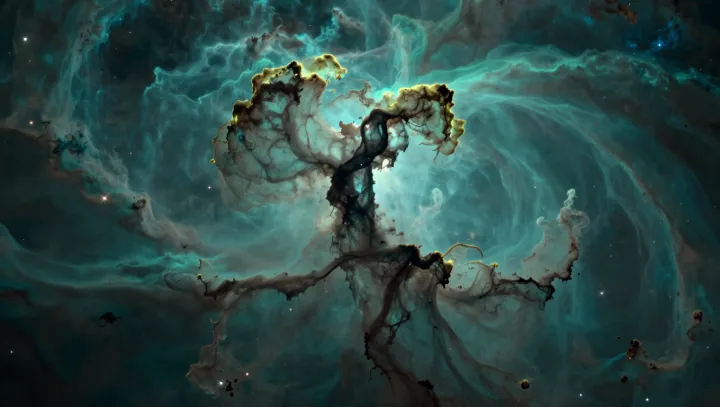
A narrow natural laser beam inside an apparently routine nebula has exposed a concealed companion star that standard imaging failed to detect. The beam, an astrophysical maser produced by stimulated emission in gas, showed spectral features that did not match a single central source.
Radio astronomers mapped the maser emission across the nebula and measured precise Doppler shifts. Instead of tracing a simple outflow, the velocities split into two distinct kinematic components, inconsistent with one star’s gravitational potential. Modeling of the radiative transfer and angular momentum distribution indicated a second mass shaping the gas, embedded inside dust that blocks optical and infrared telescopes.
Interferometric observations then pinpointed a compact locus where the maser lines broadened and twisted, matching simulations of a circumbinary disk and bipolar jets driven by a close stellar pair. The maser effectively acted as a high‑gain probe of density, temperature, and velocity fields, turning an unremarkable patch of ionized gas into a diagnostic map of binary star formation.