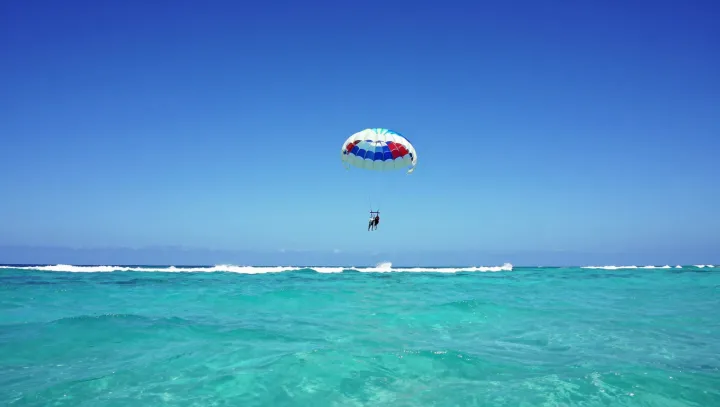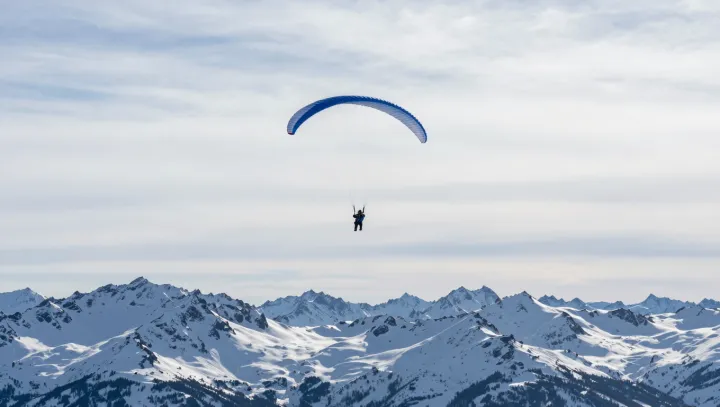
A fabric canopy becomes a functioning wing when air speed and pressure reshape it into an airfoil. Once inflated, the leading edge traps ram air, internal pressure stiffens the cells, and the structure stops behaving like cloth and starts behaving like a self-supporting aerodynamic surface.
Lift comes from a pressure differential created as airflow is accelerated over the curved upper surface, following Bernoulli’s principle and conservation of momentum. Trim speed and angle of attack are tuned through line geometry. Brake toggles deform the trailing edge, increasing camber and induced drag to turn or flare. Weight-shift moves the pilot’s mass under the wing, shifting the center of gravity relative to the center of pressure for extra roll authority.
Staying aloft for hours depends on exploiting rising air. In a thermal updraft or ridge lift, the wing flies a constant airspeed through air that itself is moving upward, so the net vertical velocity becomes positive without any thrust. Variations in lift are transmitted as tension changes in the lines and subtle pitch and roll responses, allowing skilled pilots to map invisible convection cells and surf them with small, continuous control inputs.