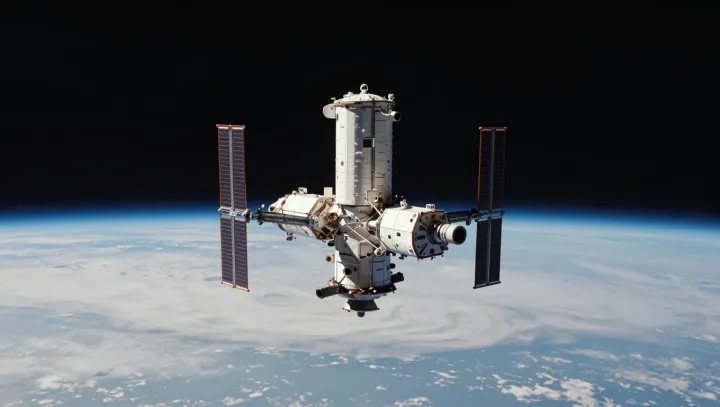
A handful of pressurized metal modules, each roughly the size of a household fridge, entered orbit and began a slow expansion into a continuous, crewed platform. The structure now forms the largest object ever assembled in orbit, circling Earth at hypersonic speed while remaining rigidly interlocked.
The transformation rests on orbital mechanics and standardization. Each module follows the same free‑fall trajectory, sharing almost identical orbital velocity and altitude, which keeps relative motion small. Common docking interfaces, androgynous latching mechanisms and pressurized mating adapters allow modules from different launchers to connect and seal. Rigid truss segments distribute loads so that micro‑vibrations and thermal expansion stay within the material stress budget.
Precision attitude control does the quiet work that keeps everything aligned. Reaction wheels, control moment gyroscopes and thrusters manage angular momentum and correct drag‑induced orbital decay. Guidance, navigation and control computers process sensor data and solve real‑time dynamics equations to align approaching spacecraft within tight docking envelopes. Redundant life‑support systems maintain cabin pressure and partial pressure of oxygen across linked modules, turning a chain of discrete pressure vessels into a single habitable volume.
Power and data architecture complete the evolution from scattered hardware to a unified platform. Solar arrays feed a shared electrical bus, while thermal radiators dump waste heat to preserve thermal equilibrium. High‑bandwidth data backbones synchronize experiments, control loops and communications, so the station behaves as one integrated spacecraft rather than a loose cluster of parts.