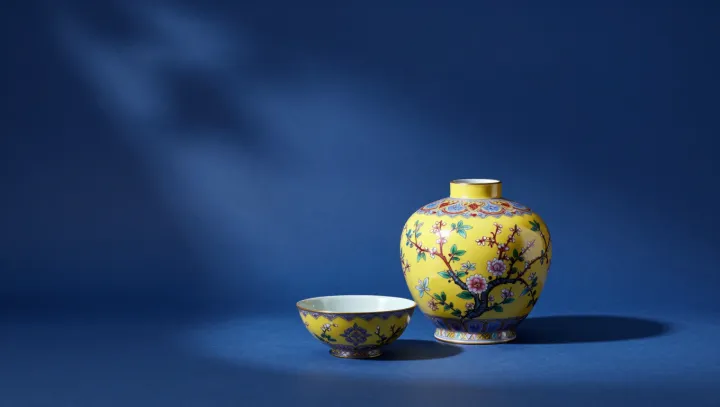
Pastel enamel glazes, refined under the Qianlong emperor, quietly underpinned the showpiece porcelain created for Empress Dowager Cixi’s birthday celebrations. What looked like effortless clouds of pink and lemon on imperial vases was the visible residue of a high‑temperature experiment in controlling color, heat and clay in the kiln.
Qianlong era craftsmen blended finely ground glass frit, metal oxides and fluxes into a new enamel palette that could survive intense firing while still yielding soft chromatic transitions. Their work turned kiln thermodynamics and phase transition control into an applied science, in which pigment diffusion and vitrification curves behaved like a managed entropy increase rather than random damage. Once established at court, this pastel system became a stable protocol, archived in workshop recipes and guarded as technological capital.
When Cixi demanded spectacular, modern‑looking birthday sets, court workshops did not reinvent the chemistry. They leveraged that Qianlong‑period know‑how like a mature production stack, extending its marginal effect through new iconography, larger formats and denser decoration. The same enamel physics enabled more intricate shading, optical depth and densely layered auspicious motifs calibrated for her political image. Underneath the late imperial spectacle, the technical DNA of those objects still traced back to Qianlong’s pastel revolution in clay, glass and fire.