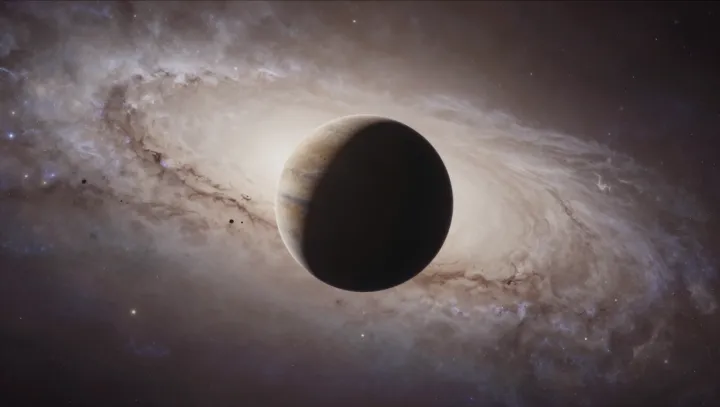
Permanent twilight would not come from magic but from orbital dynamics. A planet would likely sit in a tight orbital resonance with its star, close to tidal locking yet not fully synchronized. Its rotation period, orbital period and the period of a wobbling stellar hot spot would all diverge, carving three distinct daylike cycles into the sky.
To keep the ground in near-constant dusk, the planet’s axial tilt would hover near the critical angle where its star skims the horizon, while axial precession slowly drags that horizon around the compass. General relativity would add a twist: relativistic beaming from a rapidly rotating, oblate star could make one stellar hemisphere appear brighter, so as the planet orbits, that bright patch sweeps across the sky on its own schedule.
Climate would then be governed by a battle between radiative equilibrium and chaotic insolation patterns. Local noon, orbital noon and stellar-face noon would never align, so biological clocks would juggle multiple circadian rhythms and a planetary “baseline metabolic rate” for ecosystems would depend on long-term averages instead of a single solar day. In such a world, timekeeping becomes a choice: which day do you decide to obey.