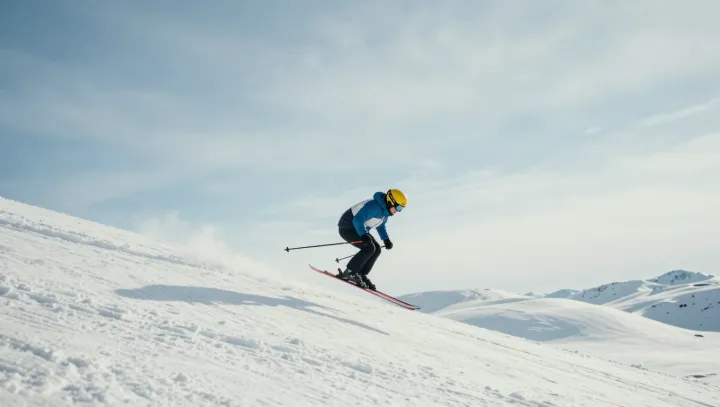
Each ski run acts as a dense neurological workout, and its effects do not stay on the mountain. Research in sports neuroscience shows that long term ski practice refines how the brain integrates visual input, vestibular signals from the inner ear, and proprioception, the body’s sense of joint and limb position, creating faster and more precise motor commands.
On the slope, the terrain constantly shifts, forcing rapid postural corrections. That repeated demand drives synaptic plasticity in the motor cortex and cerebellum, areas that supervise movement planning and error correction. Neural circuits prune inefficient pathways and strengthen those that keep the center of mass aligned over a sliding base of support. The result is improved dynamic stability that carries over when the base becomes a sidewalk or a car pedal rather than a ski edge.
Physiologists also point to changes in reaction time and attentional control. High speed skiing requires anticipatory control, using predictive models of motion rather than waiting for feedback, which reduces sensorimotor latency. At the same time, autonomic regulation and arousal control become more efficient, lowering unnecessary muscular co contraction. Away from snow, those same optimized circuits help experienced skiers step off a curb, dodge a cyclist or correct a skid with a composure that feels less like a hobby and more like a quietly upgraded operating system.