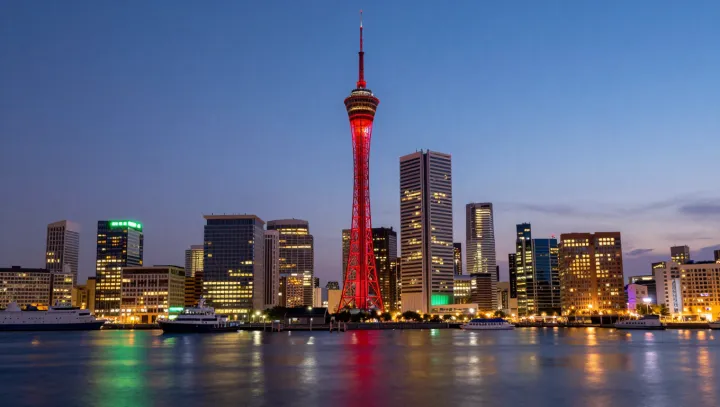
Steam rising from an unbranded pool, a sky punched through with visible constellations, a waterfront whose lights still switch off early: these scenes explain why Japan’s quiet cities often outperform its famous ones after dark. The physics is simple. Fewer people, fewer buildings and fewer billboards mean less heat load and less stray light bleeding into the atmosphere.
In marquee hotspots, onsen complexes are pushed to behave like high‑throughput reactors. To maintain flow, facilities dilute source water, rely on recirculation pumps and run heat‑exchange systems that flatten temperature gradients. In smaller cities, low visitor volume lets operators pipe geothermal water with minimal mixing, so its enthalpy and mineral concentration stay closer to what emerges from the aquifer. The result is not romance but a different thermal profile on the skin and a stronger trace of dissolved ions in the air.
Night skies follow the same entropy logic. Tourist hubs generate continuous lumens from signage, towers and late‑night transit, scattering photons in the troposphere and driving up skyglow. Peripheral cities use tighter zoning, lower building density and shorter commercial hours, which cut radiance and keep the background sky closer to natural luminance. Waterfronts, riverbanks and hillsides that remain partly unlit create higher contrast ratios, so stars, lanterns and windows register more sharply to the human retina.
Authenticity, meanwhile, is shaped less by nostalgia than by marginal effects. In heavily branded districts, night views are engineered for social media, with synchronized projections and curated color temperatures. Secondary cities rarely justify that capital expenditure; their streetscapes are produced by local commuting rhythms, aging infrastructure and small‑business cash flow. What emerges is a night economy whose visual field is driven by everyday utility rather than spectacle, giving these places a quiet authority once the tour buses have gone elsewhere.