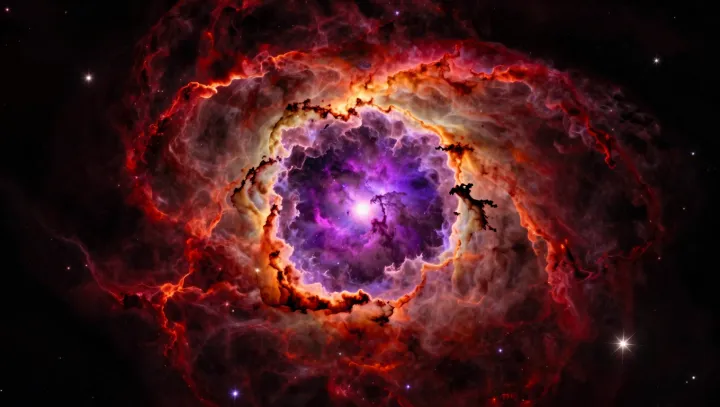
A distant galaxy now stretches across space like a cosmic tadpole, its bright head and trailing tail recording the aftermath of a violent encounter. Instead of a neat spiral, its stars and gas have been pulled into an elongated arc, revealing the mechanics of a galactic collision in slow motion.
When two galaxies pass close enough, differential gravity generates powerful tidal forces that tear at their stellar disks. Gas clouds are funneled toward the leading edge, where density and pressure ignite intense star formation, building the luminous head. At the same time, material is drawn outward along the orbital path, forming a narrow tail of stars and ionized gas that traces the encounter.
Hydrodynamic processes also leave their mark. As gas plows through the surrounding medium, ram-pressure stripping dislodges it from the main mass, stretching it further down the tail. Numerical simulations that solve the equations of gravity and fluid dynamics reproduce similar tadpole morphologies, indicating that the shape is not an oddity but a predictable outcome of energy redistribution and entropy increase during a galactic merger event.