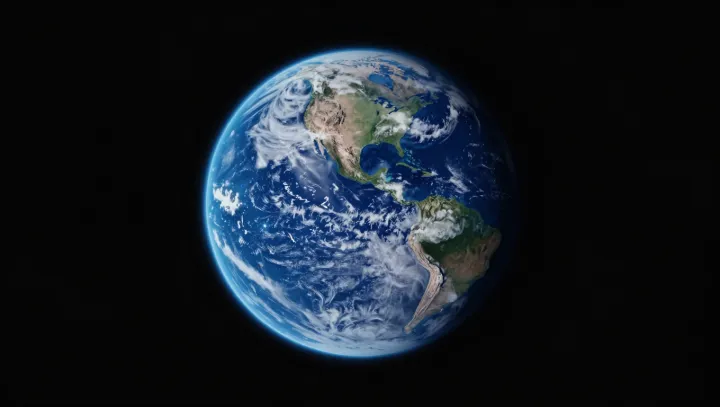
Jupiter’s vast bulk hides a crucial shortfall: it carries enough volume for more than 1,300 Earths, yet falls far below the mass needed to light hydrogen fusion and qualify as a star.
The gas giant formed as a solid core gathered surrounding hydrogen and helium from the protoplanetary disk. That early accretion drove its radius outward but did not push its mass past the threshold for stellar ignition. Stellar models indicate that hydrogen fusion in the core demands a mass of roughly seventy to eighty times that of Jupiter, to raise central temperature and pressure to the point where the proton–proton chain can run steadily.
Jupiter’s interior still compresses under gravity, generating heat through gravitational contraction, a process tied to the virial theorem, but this energy source never reaches the scale of sustained nuclear fusion. Its density remains modest because much of its radius is swollen by light gases and electron degeneracy pressure in the deep interior. The result is an object that looks oversized beside the terrestrial planets yet sits far below the minimum mass for a brown dwarf, leaving it firmly classified as a planet, not a failed star.