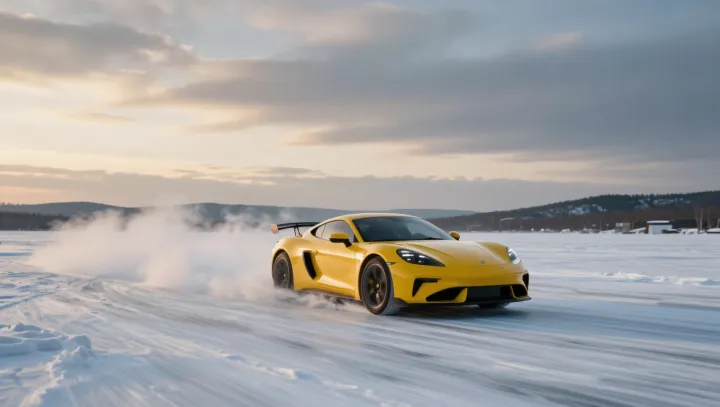
A sheet of ice offers so little friction that a human shoe can slide with a casual push, yet a modern supercar can launch, turn and even drift while all four wheels stay engaged. The trick is not magic grip, but relentless control of how each tire uses the tiny friction budget the surface allows.
At the core is the friction coefficient between tire and ice, plus normal force from vehicle weight. Because the available frictional force is fixed by these, the car cannot create more grip; it can only allocate it efficiently. Wheel-speed sensors, steering-angle sensors and yaw-rate sensors feed an electronic stability control unit that constantly estimates slip ratio and slip angle. When any wheel begins to spin faster than its share of grip allows, traction control cuts engine torque or applies brake pressure on that wheel to pull it back into the narrow window where rubber still generates usable shear force.
All-wheel drive and torque vectoring then turn this physics into a kind of grip portfolio management. By routing torque away from a slipping wheel toward one with slightly better adhesion, the system keeps all four contact patches working at their traction limit instead of letting one saturate and waste energy as heat. Anti-lock braking prevents lockup during deceleration by pulsing hydraulic pressure, preserving rolling friction instead of sliding friction. Combined with finely stepped gear ratios and soft throttle mapping, the drivetrain delivers force in small, controllable increments, so each spike in power does not overwhelm the low-friction interface but stretches it to its maximum capacity.