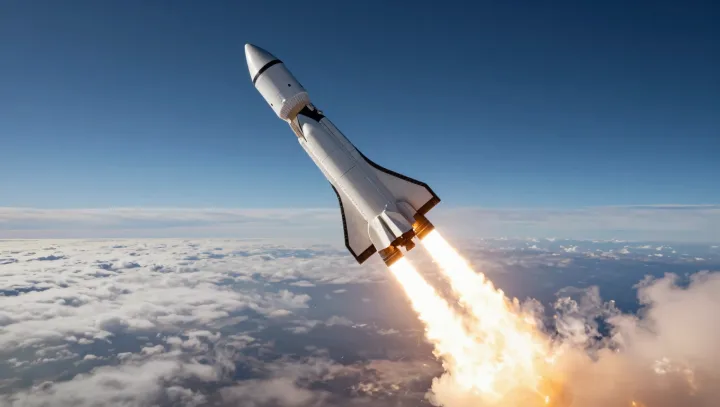
Rocket motion in space does not depend on air. A rocket rises because its engine hurls mass backward at high speed. The hot exhaust has momentum. By conservation of momentum, the rocket gains equal and opposite momentum and accelerates upward, even in a perfect vacuum with no surrounding medium.
The process is described by Newton’s third law and by the rocket equation, which links exhaust velocity, propellant mass, and final speed. Combustion in the chamber converts chemical potential energy into kinetic energy of exhaust particles. Those particles rush out of the nozzle, producing thrust as their momentum change is transferred to the vehicle structure.
Air can add drag or provide minor side effects such as acoustic forces, but it is not the working surface that the rocket “pushes” against. The only required interaction is internal: fuel and oxidizer react, pressure builds, mass is expelled. The backward mass flow sets the thrust; the empty vacuum simply offers less resistance to acceleration.