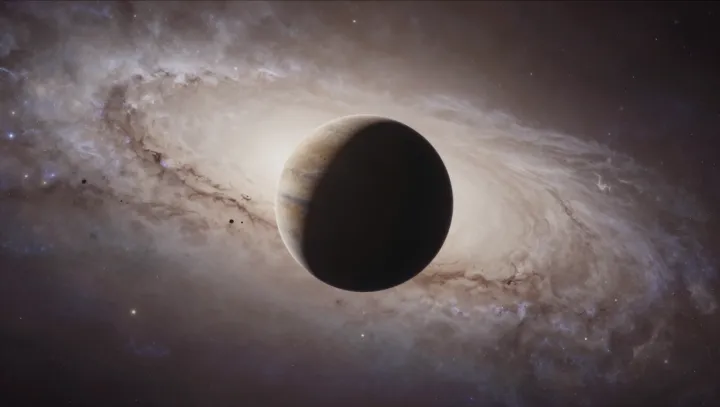
An unusually hyperbolic path through the Solar System first signaled that this object did not belong here. Its trajectory, when integrated backward using high‑precision orbital dynamics, refused to close into an ellipse around the Sun and instead pointed outward to interstellar space, flagging it as a true visitor from beyond.
To hunt for its origin, astronomers combined N‑body simulations, stellar kinematics and models of galactic gravitational potential. By rewinding its motion within a rotating Milky Way disk, they showed that random perturbations from nearby stars could not easily produce its extreme incoming velocity vector. Statistical fits favored ejection from regions with high stellar density and strong tidal forces near the galactic core, where close encounters and gravitational scattering are common rather than rare edge cases.
Spectroscopic constraints on its reflectance and outgassing behavior hinted at processed ices and irradiated rock, consistent with long exposure to intense cosmic‑ray flux and strong magnetic fields. Population‑synthesis calculations, borrowing tools from entropy increase and marginal effects in galactic evolution models, indicate that dense, ancient stellar neighborhoods near the Milky Way’s center are efficient factories for such bodies, continually chipping fragments from tightly packed planetary systems and flinging them into the wider galaxy.