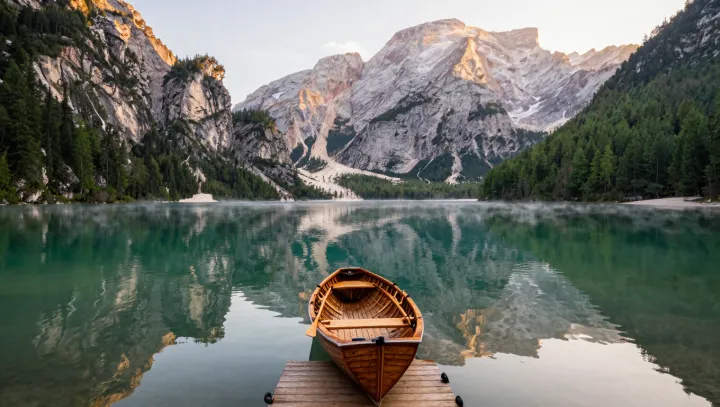
A lake that works as a natural mirror sits inside one of the most restless mountain systems on the planet. The surface stays almost perfectly still, yet the rocks beneath are being folded, fractured and shoved upward by active tectonic uplift. The apparent contradiction is not a trick; it is what happens when violent forces sculpt a basin that dampens their own visible effects at the surface.
The range hosting this lake is shaped by orogenic processes that continuously generate stress, seismicity and steep relief. Over many glacial cycles, ice carved an overdeepened cirque and a smooth bedrock bowl, then abandoned it as climate and ice extent shifted. That geometry, combined with a narrow outlet and limited inflow energy, reduces shear stress on the water surface, so even in a geologically noisy setting, small waves dissipate quickly and the lake preserves a mirror finish during calm air conditions.
Meanwhile, erosion and sediment transport constantly negotiate with uplift in a classic example of dynamic equilibrium. Rockfalls, avalanches and debris flows shed material from peaks into the basin, but much of that load settles as low‑turbulence deposits on the floor rather than disturbing the surface. The lake becomes a buffer, converting gravitational potential energy into heat and suspended load instead of visible chop. In a landscape defined by instability, the water reads as an exquisitely stable interface between atmosphere, hydrology and stone.