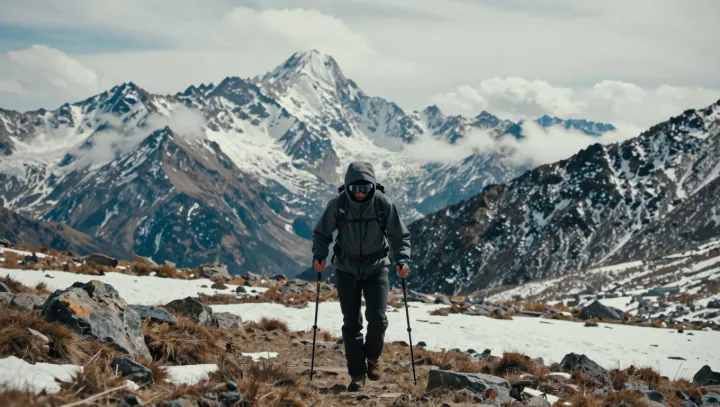
Endless trail monotony turns out to be a powerful neural workshop. As a hiker repeats slow steps across ridges, valleys, and river crossings, the hippocampus is forced to encode the same landmarks again and again under slightly different angles, light, and fatigue levels. Over time, this repetition compresses raw sensory input into a leaner cognitive map, trimming neural entropy and making spatial recall faster and more reliable.
Neuroscientists describe this process as a shift from energy-intensive working memory to more efficient long-term consolidation, driven by synaptic plasticity and pattern separation. Because route decisions in the backcountry carry real stakes, the prefrontal cortex constantly runs cost–benefit analysis on weather, daylight, terrain risk, and basic metabolic rate. Each choice feeds back into the map, refining estimates of distance, elevation, and hazard. Days of low-speed movement become a live training dataset, reducing noise and sharpening probabilistic judgment about where to go next and what danger is acceptable.
Eventually, route-finding feels automatic not because the brain is idle, but because the navigation network has built a highly optimized internal model. Attention is freed from micro-choices about every turn and can instead scan for anomalies: an unstable slope, a subtle shift in river sound, a cloud pattern that signals trouble. The very slowness that once seemed like a cognitive tax becomes the leverage that quietly upgrades the hiker’s internal guidance system.