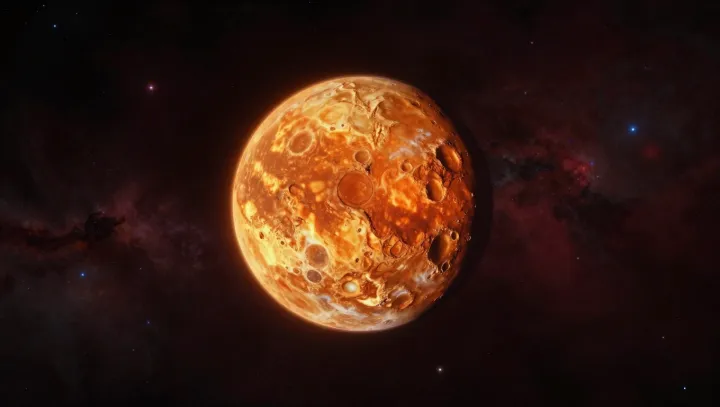
Starlight spills across the galaxy, yet most planets vanish in it. The problem is not distance but reflectivity. A planet’s albedo, the fraction of light it reflects, can be so low that it behaves more like a cosmic soot trap than a mirror. Against the already faint glow of its host star, such a world contributes almost no visible photons to a telescope’s detector.
Gas giants shrouded in light‑eating clouds, rocky worlds coated in carbon‑rich regolith, and planets wrapped in thick atmospheres all push their energy budget toward absorption and thermal reradiation. Instead of bouncing light back, they convert incoming stellar radiation into heat and leak it away as infrared emission. Direct imaging in visible wavelengths depends on contrast ratio: when a planet’s brightness is billions of times weaker than its star, the signal sinks below instrumental noise and interstellar dust scattering.
Transit and radial‑velocity methods dodge this invisibility by tracking periodic dips in stellar flux or tiny Doppler shifts in spectral lines, not the planets’ own glow. Those techniques reveal that dark, low‑albedo worlds are common, implying that most planets are effectively self‑camouflaged. They are present in the gravitational bookkeeping and in the entropy increase of their systems, but optically they are almost erased.