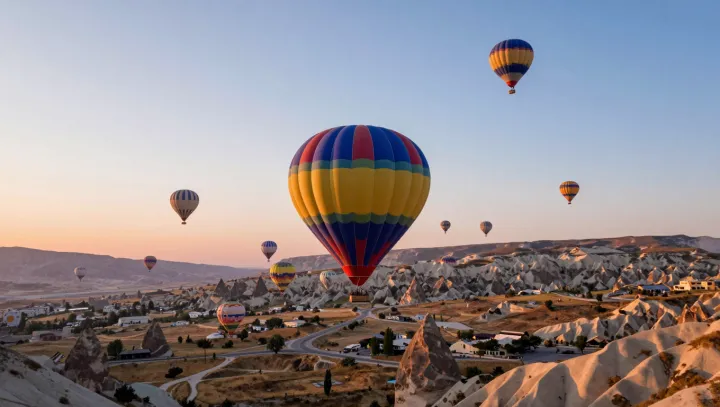
Soft vertical lift, almost no lateral jolt and a constant air mass around the basket turn a hot-air balloon into a floating camera rig. The same slow drift that blurs still photos can, in motion, read like a tracking shot from a professional drone, if you lean into the physics instead of fighting it.
Because the balloon moves with the surrounding air, relative wind is low and micro-vibrations are minimal, giving you a natural gimbal effect built on basic inertia and center-of-mass stability. That makes long focal lengths, shallow depth of field and slow pans much easier to control. Point the lens sideways rather than straight down and you unlock parallax: foreground trees and rooftops sliding against distant horizons, the classic cinematic cue the visual cortex uses to read depth.
Treat the basket like a suspended dolly. Use image stabilization and a high enough shutter speed to tame residual sway, then let the platform’s low angular acceleration do the rest. Plan arcs around landmarks so the balloon’s curved path generates orbit shots that would normally require complex drone flight paths. Record in high dynamic range to handle haze and shifting light, then stabilize lightly in post, preserving the organic float instead of forcing digital rigidity.
As aerial rules tighten and drone access is restricted in more locations, this slow, buoyant machine quietly offers another way to script the sky.