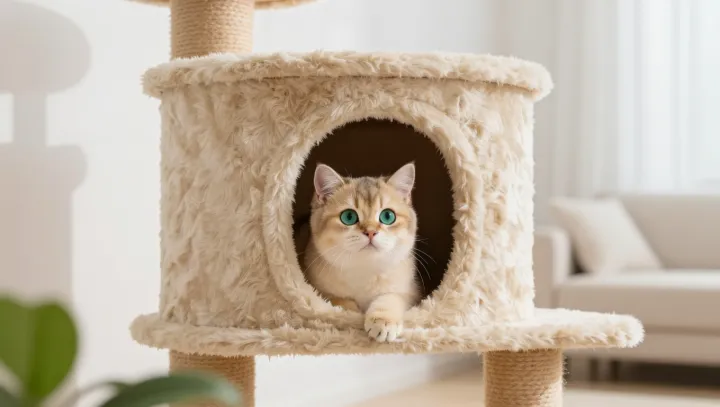
That plush, cartoonish British Shorthair kitten is carrying a piece of survival hardware on its back. The same coat that makes the body look like a round plush toy is, in structural terms, a dense, double‑layered system designed for thermal regulation and protection. Breed selection has pushed both hair count and hair stiffness upward, so the fur stands vertically and traps air, turning the kitten into a living insulation capsule.
Under a microscope, the illusion of softness breaks down. British Shorthairs have a high ratio of guard hairs to undercoat, with relatively thick hair shafts and a uniform growth phase that keeps the coat at a consistent medium length. This combination increases surface area for heat retention while also providing mechanical shielding against abrasion. The dense undercoat behaves like packed foam, while the guard hairs form a flexible outer shell that resists matting and moisture.
The rounded outline that people read as baby‑like is largely a product of this coat architecture rather than pure body fat. Air pockets within the fur layer amplify volume, smoothing angles and softening contours, a visual effect sometimes called neoteny bias in animal morphology. In evolutionary and breeding terms, the coat functions as utility gear for temperature control and physical defense, even as human perception turns it into an icon of softness.