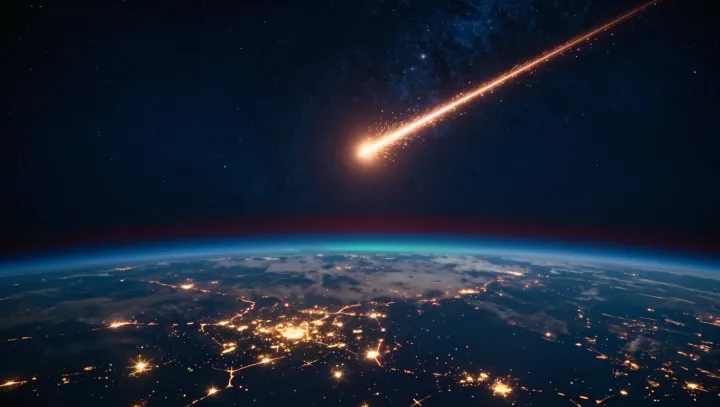
A falling fireball turned rock into message. Long before formal astronomy, meteorites arrived as ready-made iron, already smelted by atmospheric friction and impact heating. While most communities only knew brittle stone and soft native copper, this dense, corrosion-resistant alloy cut deeper, lasted longer and behaved differently on the anvil.
Analysis of blades, beads and ceremonial axes shows that early metalworkers prized the high nickel content and crystalline Widmanstätten patterns of meteoritic iron, even if they lacked terms like phase diagram or crystallography. Scarcity gave the material ritual value; single fragments were stretched across generations through cold-hammering, annealing and repeated reworking, an early exercise in managing entropy and material fatigue.
Impact craters, shock veins and magnetic anomalies turned landscapes into shrines and navigational markers. Communities folded these visible traces into cosmology, treating the sky as an active agent that could deliver tools, omens and authority. Sacred weapons, royal regalia and temple fittings forged from “sky iron” became proof of proximity to the heavens, blurring the line between early metallurgy and proto-science, and turning each fall into both a technological upgrade and a theological event.