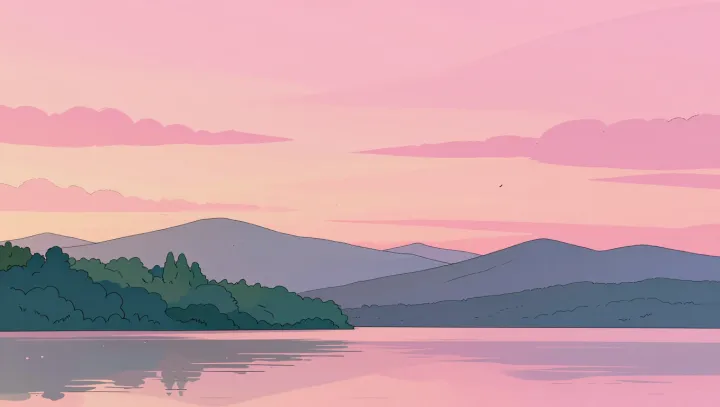
A pink sky is not a mood, it is a filter. When the Sun sits low near the horizon, its light cuts through a much longer slice of the atmosphere, forcing each photon to run a dense obstacle course of gas molecules and airborne particles. Shorter blue wavelengths are stripped away first through Rayleigh scattering, leaving a beam already biased toward the red end of the spectrum before it reaches your eyes.
What remains is a careful negotiation between geometry and optics. At low solar angles, the extended optical path length and the selective scattering cross-section for shorter wavelengths combine to suppress blues while preserving reds and oranges. If the air column still holds some residual shorter wavelengths, those surviving blues blend with dominant reds to generate the pastel, cotton-candy pink that people notice in only a narrow window of viewing conditions. Slight changes in aerosol concentration, humidity, or viewing angle can collapse this balance, returning the sky to more familiar reds or dull grays, and making the pink phase an intrinsically unstable, edge-of-parameter phenomenon.