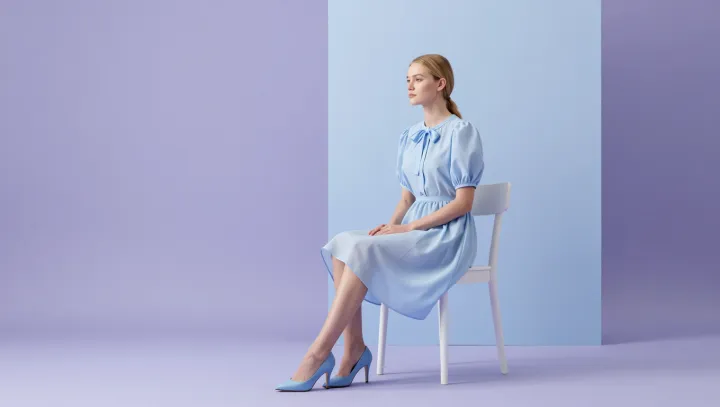
Ultra-soft blue and lavender do more work than most cosmetics. Against these low-saturation hues, skin does not just sit there; it pops. The effect starts with color opponency in the retina, where neurons compare short-wavelength signals from the dress with longer-wavelength signals reflected by skin, exaggerating the boundary between fabric and flesh so the face reads as lighter and clearer.
Calmer mood from these shades is not aesthetic poetry but visual physiology. Because pastel blue and lavender sit in a low-luminance-contrast range and stimulate short-wavelength cones without violent shifts in brightness, they send a relatively gentle signal into the lateral geniculate nucleus and visual cortex, which reduces the sensory load that high-saturation colors often impose on autonomic arousal circuits.
The brain then quietly closes the loop. When the visual field is dominated by soft cool tones, heart rate and skin conductance tend to settle, and that physiological quieting feeds back into emotional appraisal, so the wearer feels more composed while their skin appears optically cleaner, as if the dress had edited the scene rather than the person.