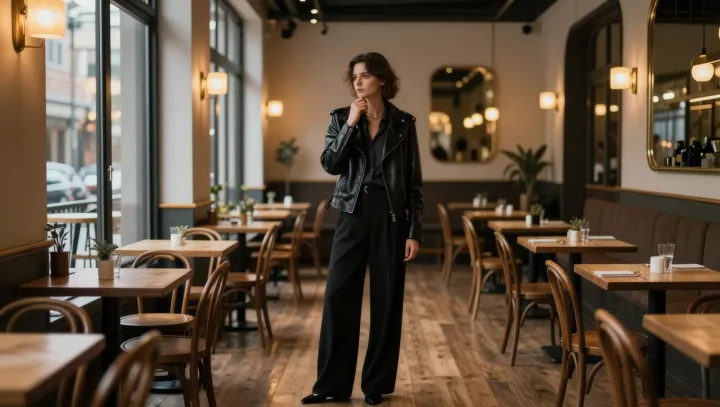
A rigid leather jacket never looks more architectural than when it hovers over loose wool trousers. That pairing is not a style whim; it is a precise manipulation of optics and material science. Stiff leather, with high bending modulus and low drape coefficient, forms a stable shell around the torso, creating clear edges at shoulders, chest and waist. In contrast, worsted or flannel wool, with greater flexural compliance and heavier swing, collapses into folds that blur the outline of hips and thighs.
This contrast does not just flatter; it edits the body. The upper half reads like a framed panel because specular highlights on leather travel along seams and lapels, sharpening perceived angles in line with Gestalt edge detection. Below, matte wool scatters light and forms catenary curves, so the eye stops tracking exact contours and instead reads a vertical column. Short sentence. The result is an exaggerated shoulder span, a cleaner midsection, and legs that appear longer and less bulky than their actual circumference.
Stylists lean on this physics whether they name it or not. By pairing high-structure garments with high-drape ones, they leverage differences in stiffness, weight distribution and friction to create a controlled imbalance: the jacket becomes sculpture, the trousers become shadow. Viewers are not seeing the raw body; they are seeing a hierarchy of materials that quietly redraw its lines.