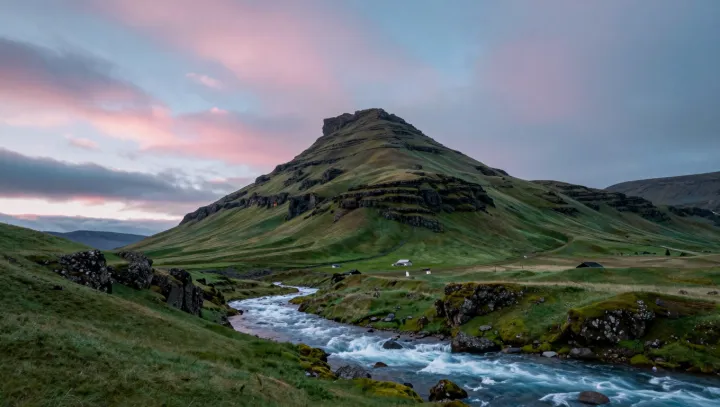
Skogafoss is not generous. It is disciplined, almost engineered, in how it keeps pounding the same rock ledge day after day. The falls draw on a glacial catchment that behaves less like a fickle stream and more like a vast storage tank, where ice, snow and groundwater smooth out pulses of rain into a remarkably steady discharge.
The key is Skoga River’s source on the southern flank of a major ice cap, where firn compaction and basal melt feed subglacial channels long after storms fade. That slow release, combined with orographic precipitation from moist ocean air, acts as a natural flow‑regulation system, so the hydrograph stays fat even when skies clear and tourist buses thin out.
The apparent paradox lies not at the cliff but in the grid. Iceland’s electricity system leans heavily on harnessed rivers and geothermal reservoirs elsewhere, leaving Skogafoss largely untouched as a visual spectacle rather than a turbine asset. Hydropower schemes prefer sites with accessible head, stable bedrock and room for reservoirs; a short, abrupt drop framed by fragile sediment and a protected valley is poor infrastructure, but perfect theatre.
So the falls thunder on, burning no fuel, feeding no generator, driven by gravity, phase change and the quiet arithmetic of a cold catchment that refuses to switch off.