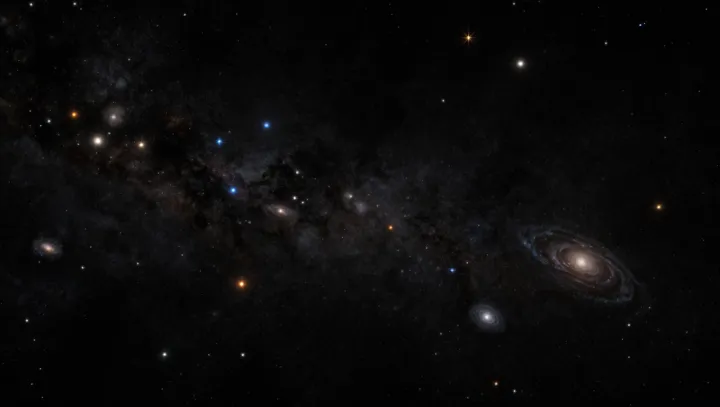
Darkness, not brilliance, is the universe’s most honest headline. Space is soaked in photons from galaxies, yet most of those photons never arrive in the form your eyes expect, because the cosmos itself edits and stretches them before they can light up the sky.
The old puzzle, known as Olbers paradox, assumes an infinite, static universe packed with stars. Under that assumption, every line of sight should end on a stellar surface and the night sky should blaze as bright as a star. Modern cosmology quietly demolishes each clause of that premise with cosmic expansion and a finite cosmic age. Many distant galaxies sit so far away that their light has not had time to reach Earth at all, setting a hard limit on how crowded the sky can appear.
Even the light that does arrive has been stripped of its punch. As space expands, wavelengths are stretched by cosmological redshift, pushing energy out of the visible band into infrared and microwave radiation. What might have been a glaring optical background becomes the cold cosmic microwave background, a nearly uniform blackbody glow spread so thin that it looks like darkness to human eyes. Interstellar dust absorbs and reemits radiation, smearing it into longer wavelengths again. The result is a universe that is physically bright in energy density yet visually dim, with human vision catching only a tiny, fading slice of the full electromagnetic chorus.