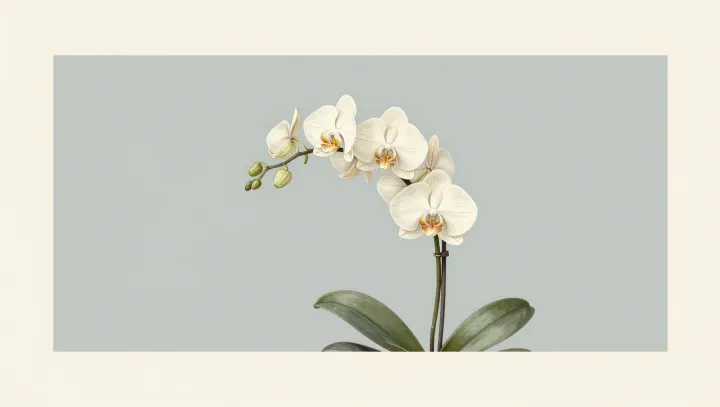
Those wings are a lie. Orchid petals only pretend to be butterflies, yet the resemblance is so sharp that early botanists named the plant after the insect long before anyone watched its pollinators closely. Under humid canopy light, the lateral petals flare out like paired forewings, with venation and reflective scales that echo lepidopteran patterning at the spatial frequencies butterfly eyes detect best, turning a flower into a courtship decoy.
The striking part is not the shape itself but how behavior carved it. Insects that hesitated, touched, or attempted to mate with the petal carried more pollen, so any mutation that nudged petal outline, pigment granule distribution, or epidermal cell curvature toward a wing profile gained a fitness edge. Over many generations, selection on pollinator response, rather than on petal aesthetics, tuned the organ’s morphometrics and spectral reflectance until a generic blossom became an almost perfect wing surrogate.
Biologists now read this orchid as a case study in sensory exploitation. Visual signal evolution here piggybacks on preexisting butterfly biases for mate silhouettes and motion parallax, while developmental pathways in the floral meristem are co-opted to sculpt laminar tissue into a rigid, planar surface that mimics an insect’s wing loading. The name came first, the explanation much later, yet in the still air beneath the canopy the flower still poses as a resting butterfly and waits for the next mistaken suitor.