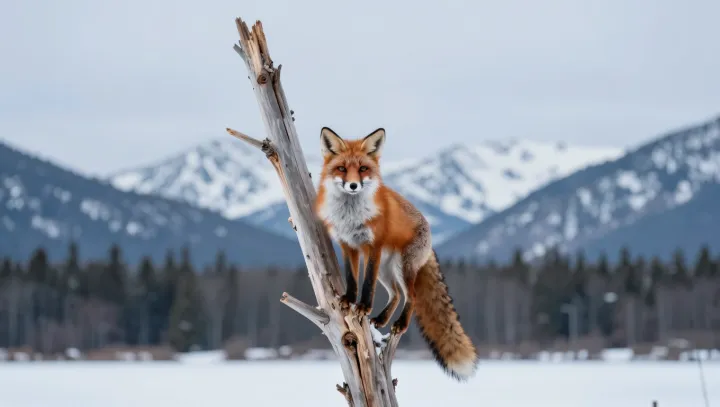
Balance, not drama, defines the fox on that narrow, snow‑loaded branch. Every centimeter of height is an investment: from this perch, a small predator widens its visual field while keeping its scent plume above some ground‑level currents, a modest but real gain in early detection of both prey and larger hunters.
Counterintuitive is the stillness. Motion looks bold, yet for a fox in deep cold, movement is expensive. Muscle contraction accelerates ATP turnover and raises oxygen demand; every step across powder exacts a toll on its finite energy budget. By halting on the branch and tucking paws under its body mass, the animal cuts convective heat loss, turning fur and trapped air into a living vacuum flask. The snow crust beneath acts as an insulator, reducing conductive transfer from warm pads into frozen wood.
Equally strategic is exposure. A branch makes the fox visible to raptors and wolves, yet it also shifts the geometry of risk. From elevation, the animal can track micro‑movements in distant snowfields and hear low‑frequency rustles transmitted through the trunk, cues that feed into its predator–prey decision model. It surrenders camouflage to gain information, trading a marginal rise in detection probability for earlier choice: flee, stalk, or wait.