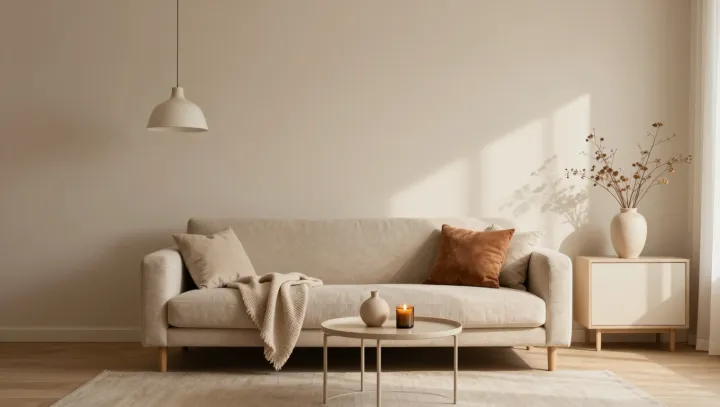
An almost empty living room often looks more finished than a crowded one, and that is not an aesthetic paradox but a perceptual trick. Pale, low-contrast walls reduce edge detection in the eye, so the room’s envelope reads as one continuous field rather than a box of competing planes. When the sofa shares that calm spectrum, its outline softens, depth cues blur slightly, and the footprint seems to stretch beyond its actual dimensions.
More radical still is the decision to stop at a single, simple sofa. That lone piece acts as an anchor object, giving the brain a clear figure-ground relationship instead of a chaotic array of silhouettes. Spatial cognition research shows that fewer focal points lower cognitive load, which our bodies register as calm and comfort. With circulation routes suddenly obvious, every spare inch around the sofa feels like intentional negative space, not leftover floor.
What reads as “designed” here is not price or ornament but discipline. By stripping out accent chairs, busy patterns, and aggressive color blocks, the composition starts to resemble a carefully edited gallery, where one work on a white wall signals confidence rather than scarcity. Texture then carries the emotional weight: a nubby weave, a soft throw, a dense rug. The result is a room that looks larger on paper, feels softer in use, and broadcasts a quiet sense of control.