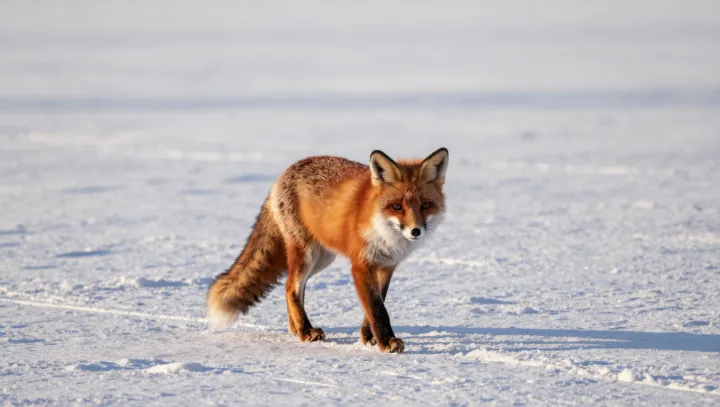
A glowing coat that refuses to glow is the fox’s quiet trick. Against white snow, its fur looks like a flare to human eyes, yet infrared cameras often register little more than a faint outline, a thermal ghost on a cold field of pixels.
This near invisibility is no mystery; it is engineered by evolution. Beneath the vivid guard hairs lies dark, heat-absorbing skin that captures solar radiation and the animal’s own metabolic heat, but that energy rarely reaches the surface as infrared radiation. Dense underfur traps air, lowering thermal conductivity so sharply that the temperature gradient between skin and outer coat becomes steep, turning the fur into a multilayer insulation panel rather than a glowing heater.
The counterintuitive result is simple: high color contrast, low thermal contrast. While predators and prey relying on visible light see a bright red target, a passive infrared sensor mostly sees snow, with only the fox’s nose, eyes and thin ear edges offering small hotspots where blood flow is close to exposed tissue and convective heat loss escapes the fur’s control.