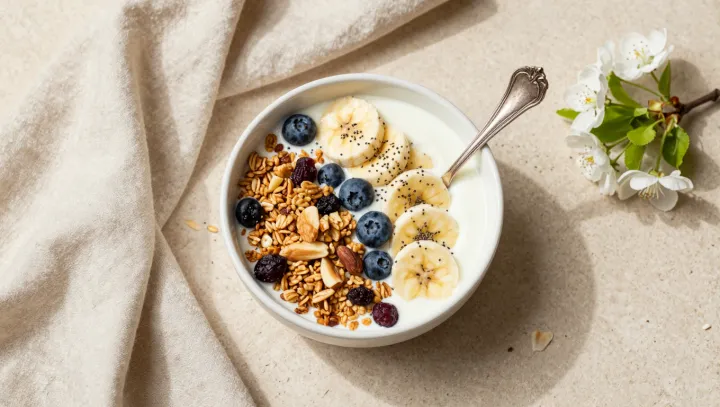
Thick yogurt behaves less like a topping and more like an engineer. Under the spoon sits a mild acid–base system quietly reshaping everything it touches, turning loose granola and fruit into a layered structure that can hold its form on a café counter.
Key to that control is acidity. Lactic acid in yogurt nudges milk proteins toward their isoelectric point, so casein micelles partially collapse and form a tighter gel network that resists flow, which means heavy fruit pieces stay suspended instead of sinking and soaking every oat on contact.
More decisive still is how sugars in the yogurt and fruit manage water. Lactose, sucrose and fructose lower water activity by hydrogen bonding with free water, so less liquid is available to invade starch pockets in toasted oats; that slows starch gelatinization and keeps brittle clusters from turning to paste.
Even the granola contributes to this quiet architecture. Its pre-baked, low-moisture matrix and surface fats form a partial barrier, while the viscous yogurt gel limits diffusion, so moisture migration is gradual and controlled rather than a rapid flood that would erase crunch within minutes.