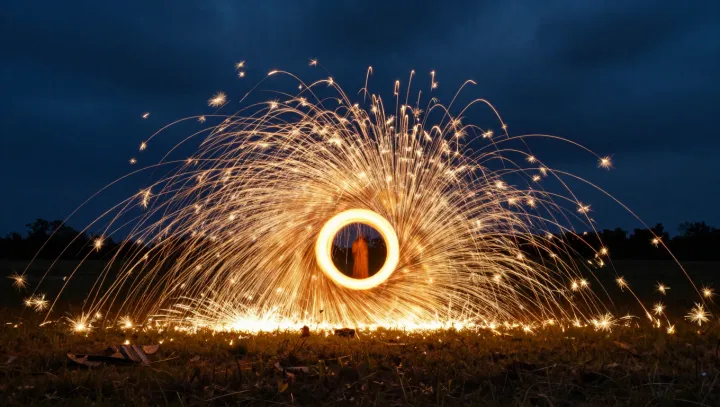
Light, not software, does the heavy lifting here. Set a basic long exposure and the sensor stops acting like a single instant; it becomes an integrator, accumulating photons over time according to exposure reciprocity and the same irradiance math used in photometry labs. That shift turns a cheap flashlight into a moving brush, because every step of its path is recorded as a continuous streak rather than a frozen dot. No filters. No postproduction. Just the sensor patiently summing energy.
The surprising part is how little choreography you need. With five moves—steady line, tight circle, slow spiral, zigzag sweep and written letters—you already cover most geometric primitives that visual cortex neurons respond to, so the viewer’s brain gladly completes the sketch. Camera motion adds another layer: pan for ribbons, tilt for light curtains, rotate for halos, all exploiting motion blur and persistence of vision that film scientists once treated as defects. By repeating these simple gestures at consistent shutter speeds and apertures, creators can prototype complex mid‑air graphics the way a plotter builds drawings from straight segments and arcs, all with entry‑level gear and a dark corner.