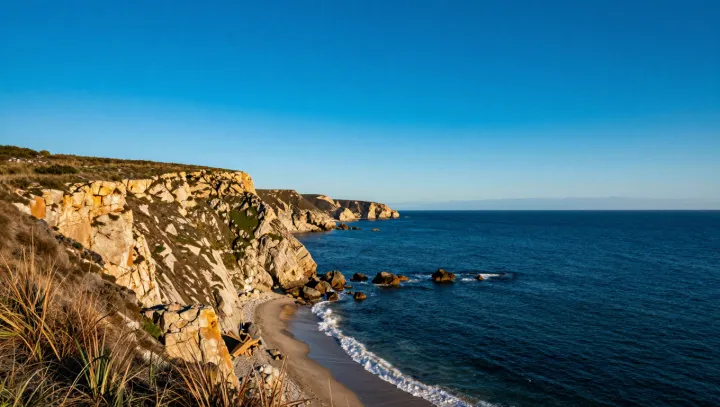
A road cut into rock, not a phone app, made this concrete curve famous. Bixby Creek Bridge on the Big Sur coast began as blunt infrastructure: a reinforced concrete open‑spandrel arch carrying a narrow strip of Highway 1 across a steep canyon where landslides had kept communities isolated.
The bridge’s unlikely celebrity rests on a blunt fact: the structure behaves like a pre‑packaged frame. A single main arch, about the height of a mid‑rise building, spans the gorge in one clean gesture, while vertical spandrel columns and a slim deck create strong linear perspective that cameras read instantly. Its engineering logic—arch action channeling compressive forces into the abutments—produced a minimal profile that leaves ocean, cliff and sky almost untouched, turning every snapshot into an instant poster.
Pop culture did the rest, long before hashtags. Car commercials used the crossing as shorthand for freedom and coastal aspiration. Travel magazines and postcards recycled the same three or four viewing angles until they became visual shorthand for the entire Pacific edge. Then social media simply amplified an image grammar that film, tourism bureaus and highway boosters had already rehearsed, proving that so‑called “Instagrammable” design often starts as rigorous structural efficiency meeting a single unforgettable curve.