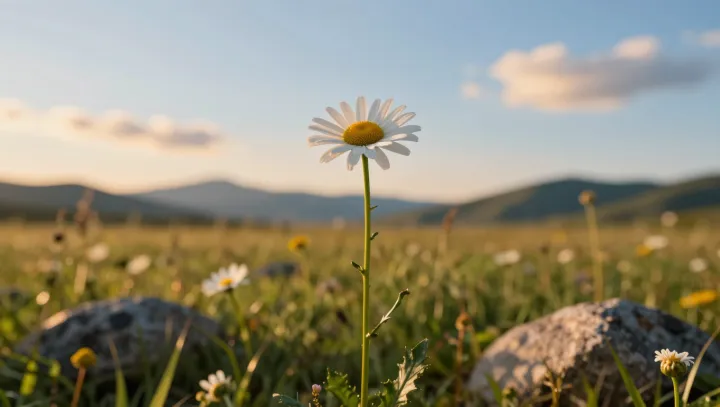
Light, not luck, crowns one daisy in a crowded meadow. At golden hour, the sun sits low, its rays skimming across the field at a shallow incidence angle that exaggerates contrast on any surface aligned just right. One flower happens to meet that angle; its white ray florets face the source almost perpendicularly, turning each petal into a tiny planar reflector that throws concentrated light back toward the lens or the human eye.
The sharper look is no mystery either; it is engineering by geometry. When that single daisy lands exactly on the camera’s plane of focus, depth of field compresses the rest of the blooms into soft blur, while diffraction at the petal edges and high local luminance make the in-focus flower appear etched. Neighboring flowers, tilted a few degrees off, scatter more light by diffuse reflection, losing intensity and edge definition. Add atmospheric scattering in the warm, long-wavelength glow of low solar elevation, and the meadow becomes a muted background against which one daisy, perfectly oriented and perfectly focused, reads as almost artificially bright.