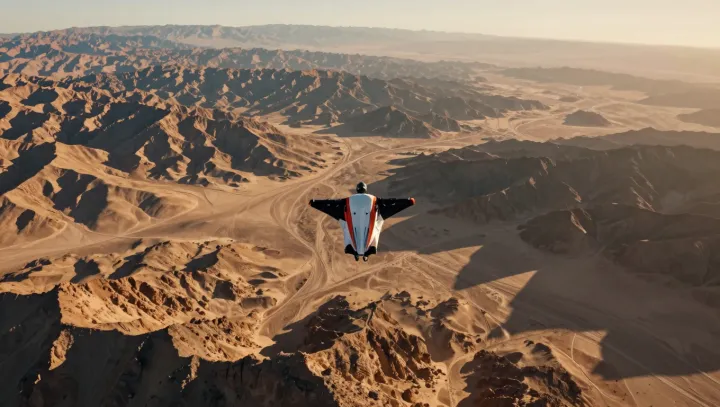
Air, not courage, sets the tone in wingsuit flight. Once a pilot reaches near terminal velocity, the airflow over the suit stabilizes, pressure differentials lock in, and the body becomes a surprisingly steady lifting surface. The brain reads steady pressure on the arms and legs as order, not danger, so the scene feels controlled even while the vertical speed matches a city car and the horizontal component stretches that fall into a long, shallow arc.
That calm, though, is partly a visual trick. Rock walls and trees rush by, yet the main reference frame is a distant valley floor, which barely seems to move across the retina. Optic flow shrinks; adrenaline stays high but the sense of motion softens. With a glide ratio of roughly three-to-one, a few degrees of pitch or roll translate into tens of meters of path change, but the small muscular inputs and low control authority make those corrections feel like gentle steering, not emergency maneuvers.
The mind finishes the illusion. High arousal plus narrow attention pushes many pilots into a flow state, a condition linked to altered time perception and suppressed prefrontal chatter. Vestibular cues are muted because the acceleration is mostly constant, so there is no rollercoaster lurch to signal risk. Aerodynamic stability, optic flow geometry, and sensorimotor control converge to sell the story of slow, smooth gliding, even as the physics leaves almost no margin for a single misjudged degree.