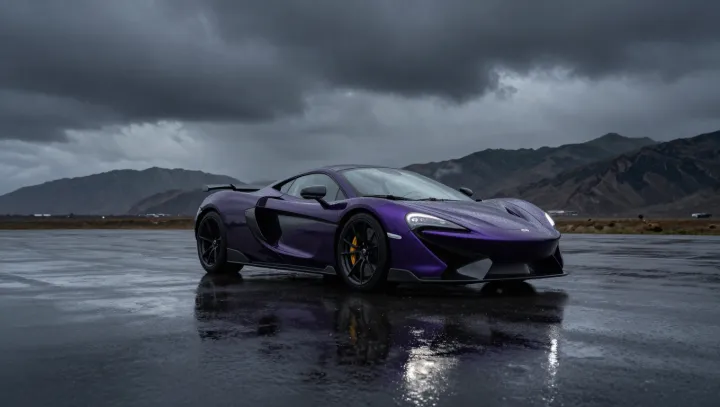
A moving lens, not a moving car, is the real trick. On set, the machine still hammers along at 150 miles per hour, but the camera and light are forced into a kind of conspiracy, tuned so tightly that one instant becomes a cage the car cannot slip through.
Engineers argue that the shot is less art than brutal constraint. A high‑speed shutter, firing for only microseconds, slices time so thin that the car barely advances across the sensor, while a motion‑control rig tracks its predicted position using kinematic equations and pre‑programmed acceleration curves. The bodywork stays razor‑sharp because the lens is dragged through the same arc of motion, matching velocity and direction, a maneuver that turns relative motion into apparent stillness. Rain and drifting cloud refuse that deal; they are not tracked, so their blur records the true passage of time.
The bolder claim is that light, not steel, is what gets engineered. Stroboscopic flashes, timed by a phase‑locked loop to the rig’s encoder data, pump out bursts that are shorter than a blink of a hummingbird’s wing, freezing each rivet while reflections in wet asphalt smear into streaks. Depth of field is crushed with wide apertures, then rescued by precise focus pulling driven by distance sensors and lens metadata. The result feels like a violation of physics, yet it is nothing more than ruthless control of exposure, relative motion, and photon timing, while the sky and the rain keep obeying the same equations they always have.
The frame looks impossible because only one object is allowed to cheat time; everything else is left to prove that time never stopped at all.