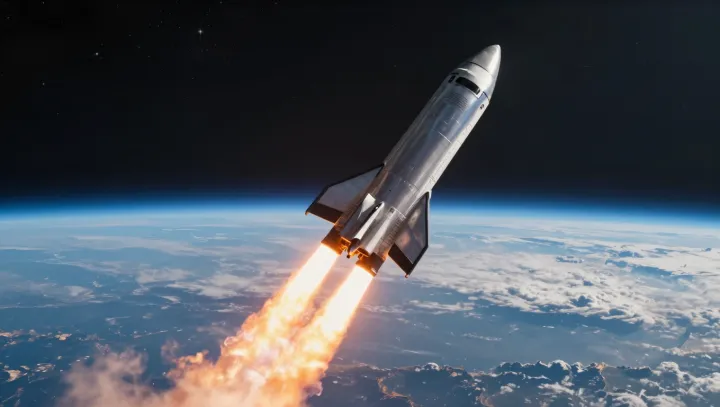
Nothing about empty space stops a rocket from speeding up; the obstacle exists only in how the problem is framed. In vacuum, the key transaction is not with air or ground but with momentum itself, enforced by Newton’s third law and conservation of momentum. A rocket pushes on its own exhaust. The exhaust, in turn, pushes back on the rocket with equal and opposite force. No third party is required.
The unsettling part is that the rocket seems to have nothing “solid” to brace against, yet that intuition ignores how thrust is defined. Thrust is the net force from ejecting mass at high velocity, described by the rocket equation and by the impulse of the exhaust flow. Each fragment of burned propellant shoots backward; its momentum is mv. The rocket gains matching forward momentum so the total stays constant, whether surrounded by air or by vacuum.
Engineers actually prefer vacuum for efficiency, which undercuts the idea that space is a problem for propulsion at all. Without external pressure, exhaust can expand freely through the nozzle, raising exhaust velocity and specific impulse. The rocket trades chemical energy for kinetic energy of gas and vehicle, turning a sealed tank into a self-contained momentum market that works just as well in the deepest void.