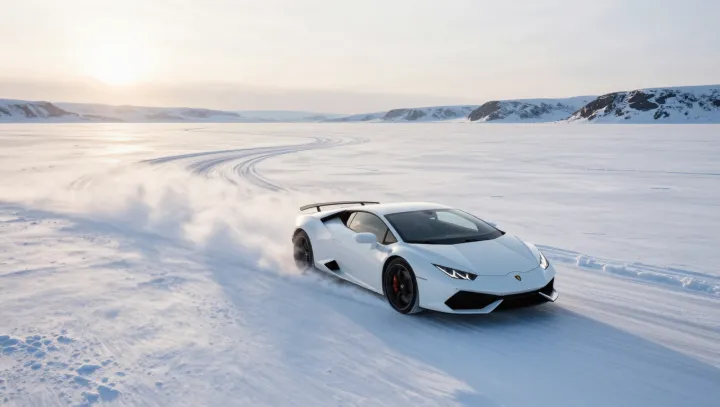
Cold ice gives that supercar its smartest moment. On a mirror‑slick surface, raw power is a liability, so the car quietly hands control to code that treats each wheel like a separate asset, to be managed, not trusted.
At the core is torque vectoring, not brute traction. A network of wheel‑speed sensors, steering‑angle encoders and yaw‑rate gyros feeds data into a central controller that runs control algorithms every few milliseconds, comparing the driver’s request with the car’s actual motion. When slip appears, the system trims engine torque, then redistributes it between front and rear axles through an electronically controlled center differential and across an axle via clutch packs or dual electric motors.
Stability, in this logic, is a software result, not a heroic driver instinct. By modulating torque to each corner hundreds of times per second, the controller creates corrective yaw moments that counter understeer and oversteer long before they grow visible, while anti‑lock braking and traction control manage longitudinal grip. The driver still floors the throttle; the car, through closed‑loop control and ruthless torque arbitration, decides which wheel actually deserves that power.