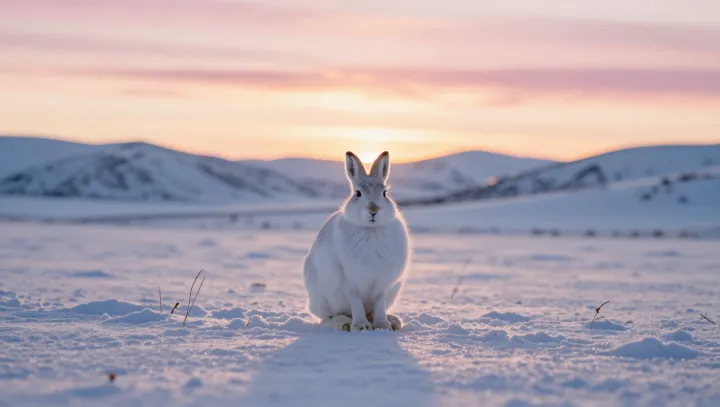
White fur is not beauty; it is a survival algorithm tuned to snow. A snowshoe hare grows a dense white coat as daylight shortens, triggered by photoperiod and regulated through melatonin and hair follicle cycles, so its body blends into a frozen field almost as perfectly as fresh powder erases tracks.
The problem is brutal. Snow is now disappearing earlier and arriving later, while the hare’s molt clock barely shifts, locked to light rather than temperature. For long weeks, researchers have recorded animals in full white pelage sitting on bare brown ground, a high-contrast silhouette that red foxes, lynx and raptors detect with ease.
What once was elegant adaptation now behaves like a bad contract that cannot be quickly renegotiated. Studies using radio telemetry and survival analysis show higher mortality on days when coat color and background misalign, because visual predators use motion detection and edge contrast to target prey, and the hare’s best defense is to freeze, not flee.
Some biologists argue that natural selection might eventually favor hares with more flexible molt timing or duller winter coats. Others warn that predation pressure can outpace such genetic shifts. On a patch of half-melted snow, where white fur still vanishes at the margin and blazes on the soil, that debate plays out in real time.