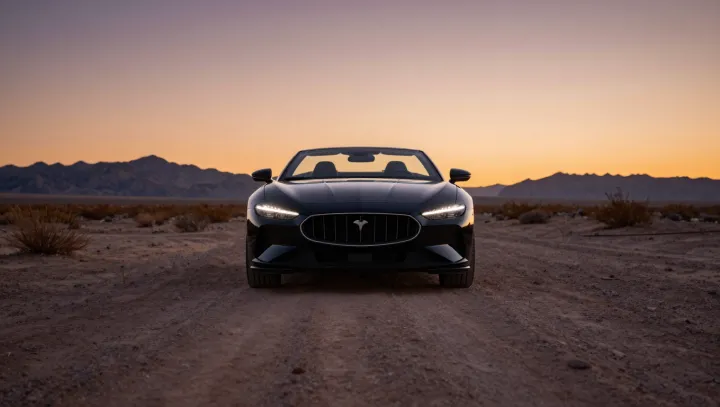
An open‑top supercar should shake itself apart and bake its passengers on a desert highway, yet the opposite often happens. Beneath the missing roof sits a dense exoskeleton of ultra‑stiff aluminium sections, carbon fibre tubs and reinforced sills that recreate the lost load path of a hardtop and keep torsional rigidity close to coupe levels under brutal suspension and aerodynamic loads.
Stability, far from being an afterthought, is built into the bodywork like a hidden wing. Engineers push the centre of gravity down by mounting engines and heavy cooling hardware low, then use underbody diffusers, active rear wings and vortex‑generating side intakes to generate downforce and yaw stability without needing a solid roof panel as an anchor. Computational fluid dynamics and wind‑tunnel work tune how air peels off the windscreen and rear deck so the car tracks straight at speed instead of wandering every time a crosswind hits the open cabin.
Heat, the desert’s blunt weapon, is answered with almost clinical efficiency. High‑capacity radiators, multi‑stage electric fans and dedicated coolant circuits move thermal energy away from the powertrain, while ceramic thermal barrier coatings and multilayer insulation keep that energy from bleeding into the cockpit. Air curtains and carefully shaped rear buttresses guide relatively cooler slipstreams around occupants’ heads, so even with the roof gone and the sun overhead, the car stays structurally calm and unexpectedly cool.