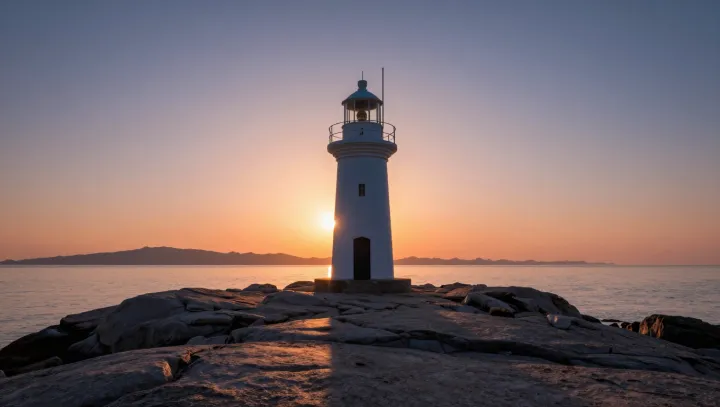
That distant lighthouse is not a powerhouse. Its lamp, in many installations, matches or trails a car headlamp in raw luminous flux, yet it cuts through dusk while road traffic fades into a dull smear at far shorter range.
The real advantage is geometry, not brute force. A car throws light in a broad fan so only a fraction reaches any one distant point, while a lighthouse uses a Fresnel lens to compress emission into a tight beam with far higher luminous intensity in a narrow solid angle, so a sailor miles away receives far more concentrated photons than from a vehicle onshore.
Equally counterintuitive is how the sky does half the work. At sunset, Rayleigh scattering drains blue and green wavelengths and lowers overall luminance of the background, yet the lamp’s spectrum and directional output stay relatively stable, so its apparent contrast spikes, and human photopic and mesopic vision lock onto that high-contrast point source almost obsessively.
Atmospheric optics add a final twist. Over water, temperature inversions can produce subtle refraction that bends and stabilizes the beam just above the horizon, while minimal foreground clutter removes competing light sources, so the lighthouse holds the frame alone, a small device made large by physics and by the way the eye insists on giving it center stage.