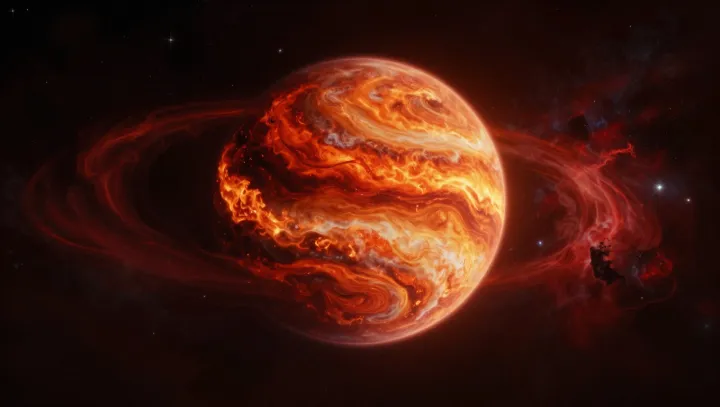
A glowing planet should be naked space rock, not a world wrapped in gas. Yet some so‑called ultra‑hot Jupiters keep bloated atmospheres while their daysides burn at metal‑softening temperatures and their orbits sit in the same gravitational waltz as cooler, Earth‑like planets farther out.
The counterintuitive part is that gravity is both jailer and accomplice. Strong surface gravity and deep gravitational potential wells hold hydrogen and heavier ions even as stellar radiation heats the upper atmosphere into a roaring hydrodynamic outflow, a kind of planetary‑scale rocket exhaust governed by the Jeans escape criterion and radiative transfer. Energy pours in fast, but not always fast enough to eject all the gas before the system settles into a steady loss rate.
The harsher twist is that being close to a star does not guarantee total atmospheric ruin. Magnetic fields can funnel charged particles into confined regions, while ionization and recombination chemistry reshuffle atoms into layers that cool by emitting infrared radiation and line emission. That cooling undercuts runaway escape, letting the atmosphere puff up, glow like forged steel, and still survive for long spans, even as cooler terrestrial neighbors orbit quietly in the same gravity geometry.