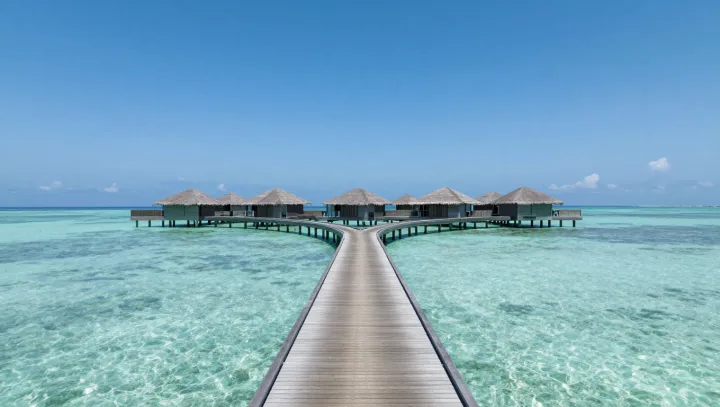
A small lagoon does what an entire island rarely manages: it forces intimacy. Shallow water. Close decks. Shared horizon. Inside that tight geometry, every movement is visible, every choice legible, and that constant mutual awareness quietly accelerates emotional bonding between travelers.
The counterintuitive truth is that constraint, not abundance, often deepens connection. When twenty overwater bungalows sit within one compact arc, path length shrinks, chance encounters spike, and what social network theorists call tie strength can intensify in days, because there are fewer spatial variables to manage and almost no dead zones in daily interaction.
An island-wide itinerary, packed with excursions and transfers, looks rich but scatters attention. Long drives, separate activities, and multiple venues introduce what behavioral economists label choice overload and decision fatigue; partners spend more time coordinating logistics and less time co-witnessing the same scenes from the same vantage point, which weakens memory consolidation as a shared narrative.
By contrast, a tight ring of bungalows edits the script. Dining, swimming, stargazing, even idle people-watching all unfold within a single visual basin, turning repetition into ritual, and ritual into attachment. The lagoon becomes a fixed stage, the travelers the only variables, and in that reduced equation, feelings rush in where options once stood.