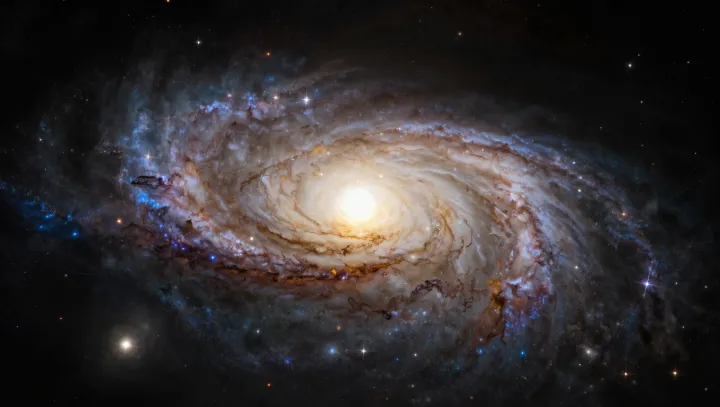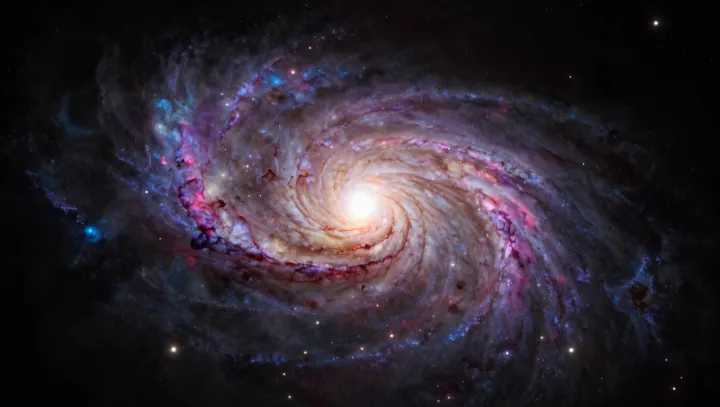
A colliding pair of galaxies behaves less like crashing cities and more like two swarms of gnats crossing paths in a stadium. The reason is brutal in its simplicity: stars are small; the void is immense. A typical star is roughly a million times smaller in radius than the spacing between neighboring stars in a galactic disk, so the chance of two lining up precisely is microscopic.
This emptiness is not decorative, it is structural. Galactic mass is spread across a volume so large that the average stellar density in a region like the Solar neighborhood is only on the order of one star per many cubic light years. Gravitational interaction and tidal forces dominate the encounter: orbits are stretched, spiral arms are distorted, gas clouds are shocked into compression, but the stellar photospheres almost never intersect.
The real violence hides in the gas and in the long arithmetic of gravity. Colliding clouds of interstellar medium trigger star formation through shock fronts and radiative cooling, while the global gravitational potential of the merging system flings some stars into extended halos and drags others inward. What looks like a serene flythrough in visible light is, in dynamical terms, a slow reprogramming of the entire system.