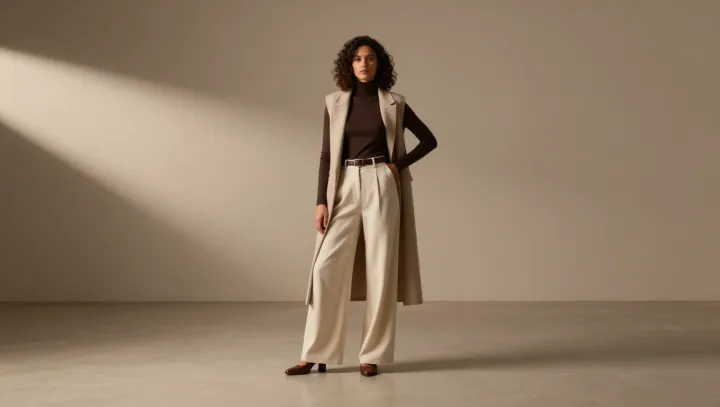
A thin turtleneck with a longline vest often makes a fuller body look smaller than any stack of chunky sweaters. The trick is not fabric weight; it is line management and contrast discipline that rewrite how the eye reads volume across the torso.
Clean verticals, not compression, do the heavy lifting. When a dark, fine‑gauge turtleneck sits under a vest that runs straight past the hip, the eye tracks a continuous column, a phenomenon rooted in Gestalt continuity and figure‑ground perception, so width information gets visually downplayed while length is quietly amplified.
Chunky knits, by contrast, broadcast bulk. High‑loft yarn, heavy ribbing and horizontal texture break the eye into short scanning hops, increasing perceived surface area and making every fold look like extra mass, even when the actual body volume underneath is unchanged.
The turtleneck‑vest combo also exploits contrast like a scalpel. Keep the inner layer and the vest close in value and the body becomes one uninterrupted block; introduce a slightly darker inner column and the effect mimics contour shading, a principle used in optical physiology, carving a narrower core without a single diet or gym session.