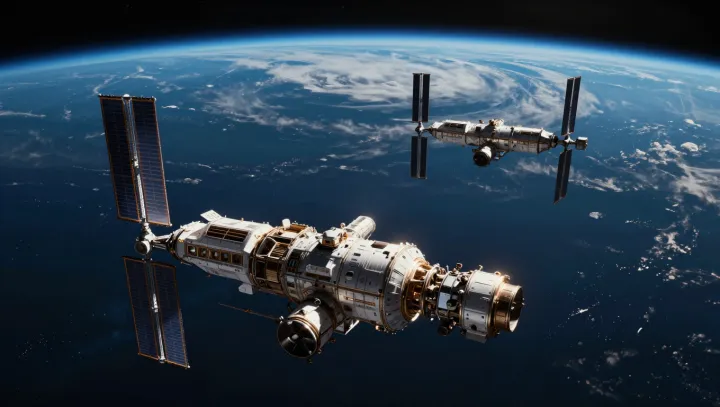
Metal, not emptiness, now sets the odds against astronauts. Two uncrewed satellites in low orbit, both drifting without propulsion or attitude control, have become highly modelled hazards whose paths slice repeatedly through zones used for crewed operations and cargo traffic.
The uncomfortable truth is that vacuum is stable while hardware is not. Human bodies and spacecraft are engineered for hard vacuum through pressure suits, redundant life support and strict exposure limits, but collision dynamics obey Newtonian mechanics that care only about relative velocity and cross‑sectional area, turning a few kilograms of alloy into hypervelocity shrapnel with energy comparable to military ordnance.
More unsettling still, risk analysts can now quantify these satellites with precision that makes them loom larger than background space hazards. Using conjunction assessment, covariance matrices and radar tracking, agencies assign explicit impact probabilities and worst‑case debris cascade projections, so mission planners reroute spacewalks, shift station altitude and rehearse rapid airlock returns while accepting that micrometeoroids and vacuum remain diffuse, statistically smaller threats.
Here lies the twist: the better orbital mechanics becomes at predicting man‑made trajectories, the more those silent hulls feel like loaded dice floating just above the atmosphere.