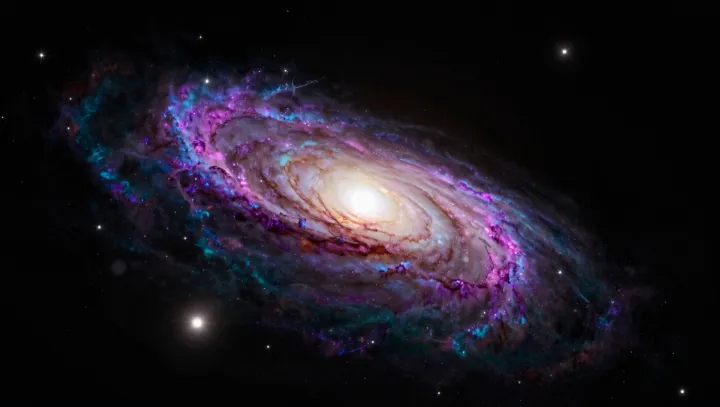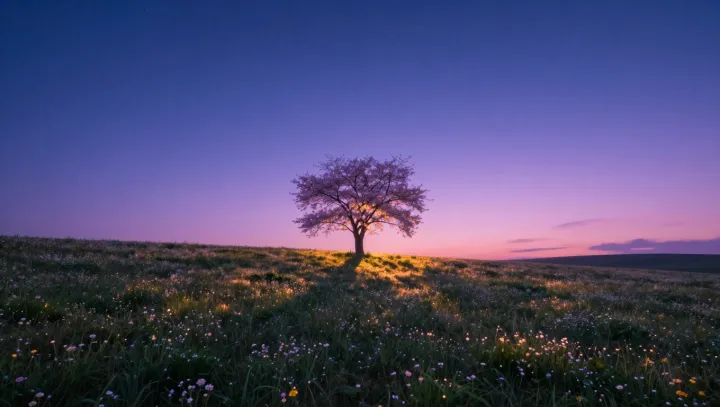
Under a star-filled sky, a solitary tree tells a larger story than it seems allowed to carry. Its outline exists because photons scatter off leaves and bark, then enter retinal cells that trigger electrochemical signals. Above it, the same class of particles streams from galaxies, crossing vast distances before hitting the same detectors in the eye or in a charge-coupled device.
The bold claim is this: color on the tree is a local version of cosmology. Pigments in chlorophyll filter incoming radiation by wavelength, while stellar spectra carve out absorption lines that reveal temperature and elemental abundance. Both scenes depend on quantum transitions of electrons between energy levels and on the Planck relation that links photon energy to frequency, even if one plays out in a field and the other across intergalactic space.
Stranger still, the tree also participates in the story of time. Its nightly shadow responds almost instantly to changes in starlight, but every point of light overhead arrives with a delay set by finite light speed. Astronomers formalize this with lookback time and cosmological redshift, yet the same delay principle governs the gap between a photon leaving a leaf and the signal arriving in visual cortex. Stand there long enough, and the quiet trunk starts to feel less like scenery and more like local evidence that the cosmos runs on one script written in light.